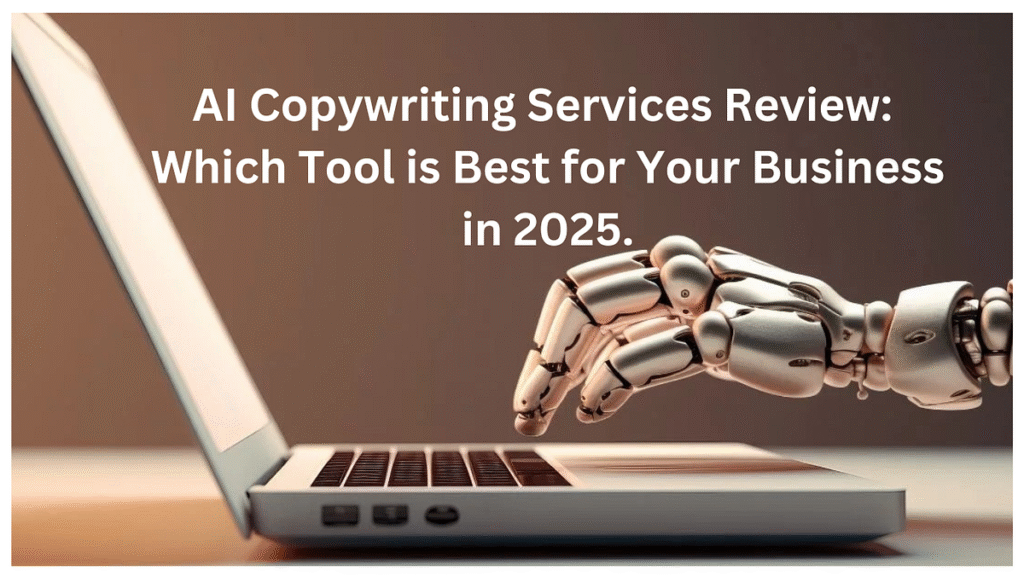
The Rise of AI Copywriting Tools: Are Human Writers at Risk?
Blog

The Rise of AI Copywriting Tools: Are Human Writers at Risk?

Table of Contents

  1. Introduction: The AI Writing Boom
  2. What Are AI Copywriting Tools and How Do They Work?
  3. The Benefits of AI Copywriting Tools for Businesses
  4. Where Human Writers Still Have the Edge
  5. Real-World Examples: AI and Human Collaboration in Action
  6. The SEO Perspective: How AI Is Changing Search Content
  7. Ethical and Trust Issues in AI-Generated Content
  8. Future Predictions: What’s Next for Writers and AI
  9. Actionable Tips: How Writers Can Thrive With AI
  10. Free Tools to Improve AI + Human Writing
  11. Conclusion: The Future Is Human-AI Synergy
  12. FAQs

Introduction: The AI Writing Boom

If you’ve spent time online lately, you’ve seen the explosion of AI copywriting tools — from Jasper and Copy.ai to Writesonic, Notion AI, and ChatGPT itself.

They promise faster content, fewer costs, and higher output. But as businesses race to automate, one question keeps surfacing:

Are human writers becoming obsolete — or just evolving?

In this deep-dive, we’ll unpack how AI copywriting tools really work, their advantages and limitations, and where human creativity still reigns supreme.

You’ll also learn actionable ways to future-proof your writing career or business content strategy in the age of AI.


What Are AI Copywriting Tools and How Do They Work?

AI copywriting tools use natural language processing (NLP) and machine learning (ML) to generate written content.

They’re powered by large language models (LLMs) — like OpenAI’s GPT-4 or Anthropic’s Claude — trained on billions of text examples across the internet.

How AI Copywriters Work in Simple Terms

  1. Input – You type a prompt like “Write a blog intro about remote work.”
  2. Processing – The AI predicts likely word sequences based on its training data.
  3. Output – It generates text that sounds natural and contextually relevant.

Essentially, AI copywriting tools don’t “think.” They predict patterns that resemble human writing — extremely well.

Popular AI Copywriting Tools in 2025

ToolBest ForPricingSpecial Feature
JasperMarketing teams$$Brand voice consistency
Copy.aiSmall businesses$One-click blog outlines
WritesonicSEO & ads$$Google Docs-style editor
ChatGPT (GPT-5)General content creationFree+Conversational generation
Notion AIProductivity writingFreeDocument summarization

Pro Insight: According to Backlinko, the key to ranking content isn’t just text volume — it’s originality and user intent alignment. AI alone can’t fully grasp that.


The Benefits of AI Copywriting Tools for Businesses

AI content generators are not hype — they’re productivity game changers.
Here’s where they shine most:

1. Speed and Efficiency

AI can generate a 1,000-word article in under 60 seconds.
For businesses managing multiple channels — blogs, ads, emails, social media — this saves hours per week.

2. Cost Reduction

Instead of hiring a full writing team, startups can use AI to draft or brainstorm content, cutting labor costs by up to 70% (Source: HubSpot State of AI Report 2025).

3. Content Ideation and SEO Research

Modern tools integrate with SurferSEO, SEMrush, or Ubersuggest, helping marketers:

  • Identify trending keywords
  • Optimize readability and density
  • Generate meta tags and outlines

4. Multilingual and Scalable

AI can instantly translate or localize content for global audiences — no translator needed.

Example: A small eCommerce store used Jasper to translate 500 product descriptions into 6 languages in 48 hours — a task that once took 3 weeks.


Where Human Writers Still Have the Edge

AI might be fast, but it’s not flawless.

1. Emotional Intelligence

Humans understand nuance — tone, empathy, and culture — in ways AI still struggles with.
Readers can feel when something is too mechanical or detached.

2. Original Thought

AI creates from what it’s learned — not from lived experience.
Human writers bring stories, case studies, and opinions that build E-E-A-T (Experience, Expertise, Authoritativeness, Trustworthiness).

3. Brand Voice and Storytelling

While AI can mimic tone, it lacks contextual awareness — the why behind your brand story.

4. Ethical Judgment

Only humans can make judgment calls about sensitive topics, misinformation, or ethics in content.

Exposure Ninja Insight: “The future isn’t AI vs humans. It’s AI-assisted creativity. The writers who learn to lead AI will replace those who ignore it.”


Real-World Examples: AI and Human Collaboration in Action

1. The Marketing Agency Hybrid Model

Agencies like GrowthBar and Content at Scale use AI for first drafts and humans for editing, fact-checking, and E-E-A-T optimization.

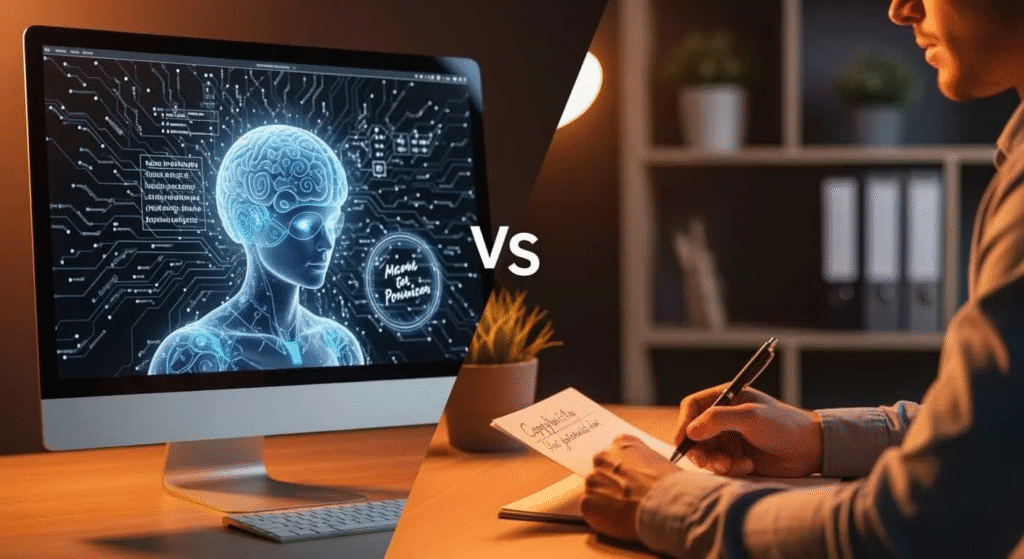
Result: 40% faster production, 25% higher content ROI.

2. Journalists Using AI for Research

Reporters at Reuters and Associated Press use AI for:

  • Data summaries
  • Market updates
  • Headline variations

Humans still write the final analysis.

3. Small Business Content Teams

Freelancers combine AI tools like ChatGPT, Grammarly, and Hemingway App to improve clarity and SEO while maintaining originality.

Stat: 61% of marketers now use AI for content creation (HubSpot, 2025), but 79% still rely on human editing before publishing.


The SEO Perspective: How AI Is Changing Search Content

Google’s Helpful Content Update emphasizes people-first writing.
That means AI content can rank — only if it’s:

  • Factually accurate
  • Edited by humans
  • Provides genuine value

AI for SEO Research

AI tools can:

  • Suggest related keywords
  • Predict search intent
  • Generate FAQ schema for snippets

But human oversight ensures the content actually answers real user queries.

The E-E-A-T Advantage

To rank in 2025, you must:

  • Demonstrate Experience through examples
  • Show Expertise via citations
  • Build Authoritativeness through backlinks
  • Earn Trustworthiness with transparency

Backlinko Tip: Pages showing firsthand experience outperform generic AI summaries by over 45% in organic click-through rates.


Ethical and Trust Issues in AI-Generated Content

1. Misinformation Risk

AI can fabricate quotes or “hallucinate” facts.
Always verify using sources like Google Scholar or Statista.

2. Plagiarism and Copyright

Since AI learns from public data, outputs can unintentionally echo existing content. Tools like Copyscape or Originality.ai help detect overlap.

3. Transparency

Brands should disclose when AI assists their writing — maintaining honesty and user trust.

MonsterInsights Note: Websites that mislead readers (e.g., hiding AI authorship) risk higher bounce rates and loss of credibility metrics.


Future Predictions: What’s Next for Writers and AI

By 2030, AI won’t replace writers — it’ll replace bad writing habits.

What’s Coming:

  • Voice-to-article AI: Create posts directly from recorded conversations.
  • Personalized AI editors: Tailored to each brand’s tone and audience data.
  • AI-authored SEO clusters: Automated pillar and topic cluster mapping.

But these tools will still rely on human direction, ethics, and narrative sense.

Quote: “AI can write a poem, but only humans know why it should exist.” — Neil Patel


Actionable Tips: How Writers Can Thrive With AI

  1. Learn Prompt Engineering – The better your inputs, the better the AI output.
  2. Fact-Check Everything – Use Google Search Console and Ubersuggest for verification.
  3. Add Human Flair – Inject personal stories, opinions, or humor.
  4. Focus on Strategy – Let AI draft; you guide structure, tone, and purpose.
  5. Build Authority – Publish thought pieces, not just keyword posts.

Pro Tip: Combine ChatGPT for ideas, SurferSEO for optimization, and Grammarly for clarity — a powerful trio for ranking content faster.


Free Tools to Improve AI + Human Writing

PurposeFree ToolBenefit
Keyword ResearchUbersuggestIdentify low-competition keywords
SEO OptimizationGoogle TrendsSpot emerging content topics
Fact-CheckingGoogle ScholarVerify citations
ReadabilityHemingway AppImprove clarity
Plagiarism CheckDuplicheckerEnsure originality

Conclusion: The Future Is Human-AI Synergy

AI copywriting tools aren’t a threat — they’re a toolkit for creative amplification.

Yes, AI can automate writing. But only humans can inspire, connect, and persuade through lived experience and emotion.

The best future isn’t AI vs writers — it’s AI with writers.

Takeaway: The next generation of top-performing content will come from human-AI collaboration — efficient, creative, and authentic.


FAQs

1. Will AI replace human writers?
No—it will replace repetitive writing. Humans will focus more on strategy, storytelling, and creativity.

2. Is AI content SEO-friendly?
Yes, if it’s fact-checked, original, and provides value aligned with Google’s Helpful Content standards.

3. What jobs will AI writing tools impact most?
Low-skill copywriting, basic ad generation, and content spinning will see automation first.

4. How can writers stay relevant?
Learn AI tools, strengthen personal branding, and focus on experience-rich writing.

5. What’s the best AI copywriting tool in 2025?
For businesses: Jasper. For individuals: ChatGPT (GPT-5) due to versatility and cost-effectiveness.


Internal Linking Suggestions

Leave a Reply

Your email address will not be published. Required fields are marked *