Table of Contents
- Introduction: Cloud vs. Edge — The 2025 Showdown
- Understanding Cloud Computing
- Understanding Edge Computing
- Key Differences Between Cloud and Edge Computing
- Advantages of Cloud Computing in 2025
- Advantages of Edge Computing in 2025
- Real-World Case Studies: Cloud and Edge in Action
- Cloud vs. Edge for AI and IoT Applications
- Security, Privacy, and Compliance Considerations
- Cost and Scalability: Which One Saves More?
- The 2025 Verdict: Hybrid Computing Wins
- Actionable Tips for Choosing Between Cloud and Edge
- Free Tools to Evaluate Your Infrastructure
- Conclusion: The Smart Future Is Hybrid
- FAQs
Introduction: Cloud vs. Edge — The 2025 Showdown
In 2025, data is the new electricity — and how fast you move it determines your success.
Businesses worldwide are now asking the big question:
“Should we rely on Cloud Computing or shift to Edge Computing?”
Both technologies are powerful. Both drive AI, IoT, and real-time analytics. But they solve different problems — and choosing the wrong one could cost you millions in performance, security, or scalability.
In this guide, you’ll learn:
- The key differences between cloud and edge computing
- Real-world examples from leading companies
- How to choose the best model for your business in 2025
- Expert predictions and actionable SEO-friendly insights
Let’s dive into what’s really happening under the hood.
Understanding Cloud Computing
Cloud computing refers to delivering computing services (servers, databases, storage, analytics) over the internet instead of local hardware.
Instead of owning infrastructure, you rent it from providers like:
- Amazon Web Services (AWS)
- Microsoft Azure
- Google Cloud Platform (GCP)
How It Works
Your data and apps live in remote data centers. When users request something — like loading a website or processing a file — that request travels to the cloud, where it’s processed and sent back.
Key Characteristics
- Centralized processing
- Scalable on demand
- Pay-as-you-go pricing
- High data availability
Stat: According to Gartner, global spending on cloud services will reach $679 billion in 2025, up 20% from 2024.
Understanding Edge Computing
Edge computing pushes data processing closer to where it’s generated — like sensors, devices, or local gateways — instead of sending everything to the cloud.
How It Works
Imagine a smart factory:
Instead of sending all sensor data to a remote cloud for analysis, edge devices process it locally in real time. Only critical or aggregated data is sent to the cloud.
Key Characteristics
- Local or near-device processing
- Ultra-low latency
- Real-time decision-making
- Reduced data transfer costs
Example: In autonomous vehicles, edge computing helps make instant braking decisions without waiting for cloud confirmation — a difference of milliseconds that can save lives.
Key Differences Between Cloud and Edge Computing
| Feature | Cloud Computing | Edge Computing |
|---|---|---|
| Data Location | Centralized (remote servers) | Decentralized (near data source) |
| Latency | Higher (internet-dependent) | Very low (local processing) |
| Scalability | Virtually unlimited | Limited by edge device power |
| Security | Centralized control | More distributed but harder to manage |
| Cost Efficiency | Great for large workloads | Great for real-time, small workloads |
| Ideal For | Big data analytics, storage, SaaS | IoT, automation, remote monitoring |
Insight from Backlinko: Performance and load times are now ranking factors. Edge computing’s speed gives it a technical SEO advantage for latency-sensitive applications.
Advantages of Cloud Computing in 2025
Cloud remains the backbone of global digital infrastructure — especially for AI and big data.
1. Unlimited Scalability
You can scale up or down instantly without investing in hardware. Perfect for startups and enterprises alike.
2. Advanced Analytics and AI Integration
Modern cloud platforms integrate AI models (e.g., Google Vertex AI, Azure OpenAI Service) for predictive insights and automation.
3. Global Accessibility
Teams can collaborate across continents in real time — all data synced automatically.
4. Cost Optimization
Pay only for what you use. Plus, tools like AWS Cost Explorer or Google Billing Reports help prevent budget overruns.
Pro Tip: Use Google Cloud’s Free Tier to prototype projects without cost. Great for SMEs testing digital transformations.
Advantages of Edge Computing in 2025
Edge is exploding thanks to IoT, 5G, and AI-driven automation.
1. Ultra-Low Latency
Processing at the edge reduces delays from 200ms to under 20ms — essential for robotics, AR/VR, and smart cities.
2. Enhanced Privacy
Data stays local, minimizing exposure risks. Ideal for regulated industries like healthcare and finance.
3. Bandwidth Efficiency
By filtering data locally, companies save up to 40% in bandwidth costs (IDC, 2025).
4. Offline Functionality
Even if cloud connectivity drops, edge devices keep systems running — critical for remote or industrial environments.
Real Case: Tesla vehicles rely heavily on edge computing for real-time decisions, while uploading summarized data to the cloud for long-term learning.
Real-World Case Studies: Cloud and Edge in Action
1. Amazon’s Smart Retail (Hybrid)
Amazon Go stores use edge computing for instant checkout (sensor data, cameras) while cloud systems handle inventory analytics and customer insights.
Result: 95% reduction in checkout time.
2. Healthcare: Remote Patient Monitoring
Hospitals use edge devices to monitor vitals in real time while cloud servers store patient records securely.
Result: Improved response times and reduced data overload.
3. Manufacturing: Predictive Maintenance
Factories use IoT sensors with edge computing for instant anomaly detection, sending only relevant alerts to the cloud.
Result: 30% less downtime, 20% cost savings (Source: McKinsey 2025 Report).
Cloud vs. Edge for AI and IoT Applications
AI Workloads
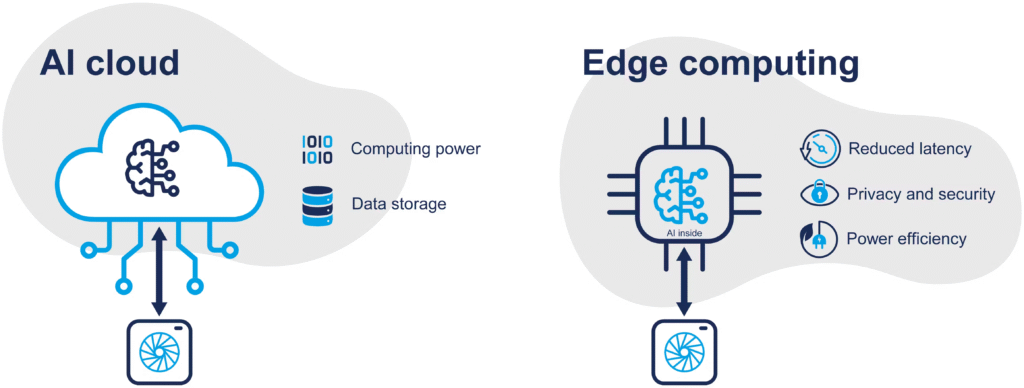
- Cloud AI: Best for training large models and processing heavy datasets.
- Edge AI: Best for inferencing (using trained models) close to devices.
IoT Ecosystems
Cloud stores historical data; edge processes real-time streams.
| Use Case | Best Option | Why |
|---|---|---|
| Smart Homes | Edge | Real-time response (lights, security) |
| Data Analytics | Cloud | High compute and storage capacity |
| AR/VR Experiences | Edge | Ultra-low latency needed |
| Machine Learning Training | Cloud | Massive compute resources |
Security, Privacy, and Compliance Considerations
Cloud Security
Centralized systems mean stronger oversight but higher stakes. Breaches can expose millions of records.
Use Zero Trust Architecture, multi-factor authentication, and tools like Cloudflare for protection.
Edge Security
Distributed nodes reduce single points of failure but increase management complexity. Each device must be secured and updated.
MonsterInsights Note: Google now prioritizes sites that demonstrate data security practices — SSL, encryption, and transparent policies — as ranking signals for trust.
Compliance
Industries under GDPR, HIPAA, or PCI DSS often prefer edge models to retain local control over sensitive data.
Cost and Scalability: Which One Saves More?
Cloud Pros
- Lower upfront costs
- Flexible subscription models
- Great for startups and global operations
Cloud Cons
- Ongoing bandwidth charges
- Vendor lock-in risk
- Latency for real-time applications
Edge Pros
- Reduced bandwidth costs
- Real-time responsiveness
- Data sovereignty benefits
Edge Cons
- Higher hardware investment
- Limited storage and processing
IDC Forecast: By 2025, 30% of enterprise data will be processed outside centralized clouds — up from just 10% in 2020.
The 2025 Verdict: Hybrid Computing Wins
Neither cloud nor edge wins alone — hybrid computing does.
What’s Hybrid Computing?
A hybrid model combines cloud scalability with edge speed.
Data is processed locally (edge) for immediate insights and then synced with the cloud for storage, learning, and long-term analytics.
Why It Wins:
- Best balance of cost, performance, and security
- Seamless failover between edge and cloud
- Ideal for AI-driven, data-heavy businesses
🚀 Exposure Ninja Insight: Companies using hybrid setups see 35% faster data processing and 22% higher operational efficiency.
Actionable Tips for Choosing Between Cloud and Edge
- Assess Latency Needs
If milliseconds matter (IoT, AR, robotics), go edge. Otherwise, cloud may suffice. - Calculate Total Cost of Ownership (TCO)
Include hardware, bandwidth, and maintenance. - Think Scalability and Compliance
Global operations? Cloud. Regulated data? Edge. - Start Hybrid
Begin cloud-first, then move time-sensitive tasks to the edge as needed. - Monitor Performance
Use Google PageSpeed Insights or Pingdom Tools to evaluate latency and network performance.
Free Tools to Evaluate Your Infrastructure
| Purpose | Free Tool | Benefit |
|---|---|---|
| Cloud Cost Estimation | AWS Pricing Calculator | Forecast monthly expenses |
| Performance Testing | GTmetrix | Analyze site and app speed |
| Network Latency Check | Pingdom | Test global response times |
| IoT Simulation | Google Cloud IoT Core (Trial) | Experiment with IoT setups |
| Edge Deployment Preview | NVIDIA Jetson Developer Tools | Test real-time edge AI models |
Conclusion: The Smart Future Is Hybrid
Cloud computing revolutionized the last decade.
Edge computing is transforming this one.
But in 2025, it’s not Cloud vs. Edge — it’s Cloud + Edge.
The smartest companies will blend both:
- Cloud for global insight and scalability
- Edge for local speed and real-time intelligence
Whether you’re a startup or enterprise, adopting a hybrid approach means future-proofing your infrastructure for AI, 5G, and the data-driven economy ahead.
Next Step: Audit your current setup using free tools above — then identify which workloads belong at the edge and which should stay in the cloud.
FAQs
1. What’s the main difference between Cloud and Edge Computing?
Cloud centralizes processing in remote data centers, while edge processes data closer to its source, reducing latency.
2. Which is better for AI applications?
Cloud is better for training AI models; edge is better for real-time decision-making.
3. Is Edge Computing replacing Cloud Computing?
No. Edge complements the cloud by handling real-time tasks while cloud systems manage large-scale storage and analytics.
4. Is Edge Computing more secure?
It can be — since data stays local — but managing many distributed nodes increases complexity.
5. How do I choose between the two?
Evaluate your latency, compliance, and cost requirements. Most modern setups benefit from a hybrid approach.
Internal Linking Suggestions
How to Optimize Website Speed for Better SEO PerformanceTable of Contents
- Introduction: Cloud vs. Edge — The 2025 Showdown
- Understanding Cloud Computing
- Understanding Edge Computing
- Key Differences Between Cloud and Edge Computing
- Advantages of Cloud Computing in 2025
- Advantages of Edge Computing in 2025
- Real-World Case Studies: Cloud and Edge in Action
- Cloud vs. Edge for AI and IoT Applications
- Security, Privacy, and Compliance Considerations
- Cost and Scalability: Which One Saves More?
- The 2025 Verdict: Hybrid Computing Wins
- Actionable Tips for Choosing Between Cloud and Edge
- Free Tools to Evaluate Your Infrastructure
- Conclusion: The Smart Future Is Hybrid
- FAQs
Introduction: Cloud vs. Edge — The 2025 Showdown
In 2025, data is the new electricity — and how fast you move it determines your success.
Businesses worldwide are now asking the big question:
“Should we rely on Cloud Computing or shift to Edge Computing?”
Both technologies are powerful. Both drive AI, IoT, and real-time analytics. But they solve different problems — and choosing the wrong one could cost you millions in performance, security, or scalability.
In this guide, you’ll learn:
- The key differences between cloud and edge computing
- Real-world examples from leading companies
- How to choose the best model for your business in 2025
- Expert predictions and actionable SEO-friendly insights
Let’s dive into what’s really happening under the hood.
Understanding Cloud Computing
Cloud computing refers to delivering computing services (servers, databases, storage, analytics) over the internet instead of local hardware.
Instead of owning infrastructure, you rent it from providers like:
- Amazon Web Services (AWS)
- Microsoft Azure
- Google Cloud Platform (GCP)
How It Works
Your data and apps live in remote data centers. When users request something — like loading a website or processing a file — that request travels to the cloud, where it’s processed and sent back.
Key Characteristics
- Centralized processing
- Scalable on demand
- Pay-as-you-go pricing
- High data availability
Stat: According to Gartner, global spending on cloud services will reach $679 billion in 2025, up 20% from 2024.
Understanding Edge Computing
Edge computing pushes data processing closer to where it’s generated — like sensors, devices, or local gateways — instead of sending everything to the cloud.
How It Works
Imagine a smart factory:
Instead of sending all sensor data to a remote cloud for analysis, edge devices process it locally in real time. Only critical or aggregated data is sent to the cloud.
Key Characteristics
- Local or near-device processing
- Ultra-low latency
- Real-time decision-making
- Reduced data transfer costs
⚙️ Example: In autonomous vehicles, edge computing helps make instant braking decisions without waiting for cloud confirmation — a difference of milliseconds that can save lives.
Key Differences Between Cloud and Edge Computing
| Feature | Cloud Computing | Edge Computing |
|---|---|---|
| Data Location | Centralized (remote servers) | Decentralized (near data source) |
| Latency | Higher (internet-dependent) | Very low (local processing) |
| Scalability | Virtually unlimited | Limited by edge device power |
| Security | Centralized control | More distributed but harder to manage |
| Cost Efficiency | Great for large workloads | Great for real-time, small workloads |
| Ideal For | Big data analytics, storage, SaaS | IoT, automation, remote monitoring |
Insight from Backlinko: Performance and load times are now ranking factors. Edge computing’s speed gives it a technical SEO advantage for latency-sensitive applications.
Advantages of Cloud Computing in 2025
Cloud remains the backbone of global digital infrastructure — especially for AI and big data.
1. Unlimited Scalability
You can scale up or down instantly without investing in hardware. Perfect for startups and enterprises alike.
2. Advanced Analytics and AI Integration
Modern cloud platforms integrate AI models (e.g., Google Vertex AI, Azure OpenAI Service) for predictive insights and automation.
3. Global Accessibility
Teams can collaborate across continents in real time — all data synced automatically.
4. Cost Optimization
Pay only for what you use. Plus, tools like AWS Cost Explorer or Google Billing Reports help prevent budget overruns.
Pro Tip: Use Google Cloud’s Free Tier to prototype projects without cost. Great for SMEs testing digital transformations.
Advantages of Edge Computing in 2025
Edge is exploding thanks to IoT, 5G, and AI-driven automation.
1. Ultra-Low Latency
Processing at the edge reduces delays from 200ms to under 20ms — essential for robotics, AR/VR, and smart cities.
2. Enhanced Privacy
Data stays local, minimizing exposure risks. Ideal for regulated industries like healthcare and finance.
3. Bandwidth Efficiency
By filtering data locally, companies save up to 40% in bandwidth costs (IDC, 2025).
4. Offline Functionality
Even if cloud connectivity drops, edge devices keep systems running — critical for remote or industrial environments.
Real Case: Tesla vehicles rely heavily on edge computing for real-time decisions, while uploading summarized data to the cloud for long-term learning.
Real-World Case Studies: Cloud and Edge in Action
1. Amazon’s Smart Retail (Hybrid)
Amazon Go stores use edge computing for instant checkout (sensor data, cameras) while cloud systems handle inventory analytics and customer insights.
Result: 95% reduction in checkout time.
2. Healthcare: Remote Patient Monitoring
Hospitals use edge devices to monitor vitals in real time while cloud servers store patient records securely.
Result: Improved response times and reduced data overload.
3. Manufacturing: Predictive Maintenance
Factories use IoT sensors with edge computing for instant anomaly detection, sending only relevant alerts to the cloud.
Result: 30% less downtime, 20% cost savings (Source: McKinsey 2025 Report).
Cloud vs. Edge for AI and IoT Applications
AI Workloads
- Cloud AI: Best for training large models and processing heavy datasets.
- Edge AI: Best for inferencing (using trained models) close to devices.
IoT Ecosystems
Cloud stores historical data; edge processes real-time streams.
| Use Case | Best Option | Why |
|---|---|---|
| Smart Homes | Edge | Real-time response (lights, security) |
| Data Analytics | Cloud | High compute and storage capacity |
| AR/VR Experiences | Edge | Ultra-low latency needed |
| Machine Learning Training | Cloud | Massive compute resources |
🤖 Expert Quote: “The future of AI is not centralized or decentralized — it’s contextual. Cloud trains the brain; edge acts as the reflex.” — Neil Patel Tech Blog, 2025
Security, Privacy, and Compliance Considerations
Cloud Security
Centralized systems mean stronger oversight but higher stakes. Breaches can expose millions of records.
Use Zero Trust Architecture, multi-factor authentication, and tools like Cloudflare for protection.
Edge Security
Distributed nodes reduce single points of failure but increase management complexity. Each device must be secured and updated.
MonsterInsights Note: Google now prioritizes sites that demonstrate data security practices — SSL, encryption, and transparent policies — as ranking signals for trust.
Compliance
Industries under GDPR, HIPAA, or PCI DSS often prefer edge models to retain local control over sensitive data.
Cost and Scalability: Which One Saves More?
Cloud Pros
- Lower upfront costs
- Flexible subscription models
- Great for startups and global operations
Cloud Cons
- Ongoing bandwidth charges
- Vendor lock-in risk
- Latency for real-time applications
Edge Pros
- Reduced bandwidth costs
- Real-time responsiveness
- Data sovereignty benefits
Edge Cons
- Higher hardware investment
- Limited storage and processing
IDC Forecast: By 2025, 30% of enterprise data will be processed outside centralized clouds — up from just 10% in 2020.
The 2025 Verdict: Hybrid Computing Wins
Neither cloud nor edge wins alone — hybrid computing does.
What’s Hybrid Computing?
A hybrid model combines cloud scalability with edge speed.
Data is processed locally (edge) for immediate insights and then synced with the cloud for storage, learning, and long-term analytics.
Why It Wins:
- Best balance of cost, performance, and security
- Seamless failover between edge and cloud
- Ideal for AI-driven, data-heavy businesses
🚀 Exposure Ninja Insight: Companies using hybrid setups see 35% faster data processing and 22% higher operational efficiency.
Actionable Tips for Choosing Between Cloud and Edge
- Assess Latency Needs
If milliseconds matter (IoT, AR, robotics), go edge. Otherwise, cloud may suffice. - Calculate Total Cost of Ownership (TCO)
Include hardware, bandwidth, and maintenance. - Think Scalability and Compliance
Global operations? Cloud. Regulated data? Edge. - Start Hybrid
Begin cloud-first, then move time-sensitive tasks to the edge as needed. - Monitor Performance
Use Google PageSpeed Insights or Pingdom Tools to evaluate latency and network performance.
Free Tools to Evaluate Your Infrastructure
| Purpose | Free Tool | Benefit |
|---|---|---|
| Cloud Cost Estimation | AWS Pricing Calculator | Forecast monthly expenses |
| Performance Testing | GTmetrix | Analyze site and app speed |
| Network Latency Check | Pingdom | Test global response times |
| IoT Simulation | Google Cloud IoT Core (Trial) | Experiment with IoT setups |
| Edge Deployment Preview | NVIDIA Jetson Developer Tools | Test real-time edge AI models |
Conclusion: The Smart Future Is Hybrid
Cloud computing revolutionized the last decade.
Edge computing is transforming this one.
But in 2025, it’s not Cloud vs. Edge — it’s Cloud + Edge.
The smartest companies will blend both:
- Cloud for global insight and scalability
- Edge for local speed and real-time intelligence
Whether you’re a startup or enterprise, adopting a hybrid approach means future-proofing your infrastructure for AI, 5G, and the data-driven economy ahead.
⚙️ Next Step: Audit your current setup using free tools above — then identify which workloads belong at the edge and which should stay in the cloud.
FAQs
1. What’s the main difference between Cloud and Edge Computing?
Cloud centralizes processing in remote data centers, while edge processes data closer to its source, reducing latency.
2. Which is better for AI applications?
Cloud is better for training AI models; edge is better for real-time decision-making.
3. Is Edge Computing replacing Cloud Computing?
No. Edge complements the cloud by handling real-time tasks while cloud systems manage large-scale storage and analytics.
4. Is Edge Computing more secure?
It can be — since data stays local — but managing many distributed nodes increases complexity.
5. How do I choose between the two?
Evaluate your latency, compliance, and cost requirements. Most modern setups benefit from a hybrid approach.
Internal Linking Suggestions
How to Optimize Website Speed for Better SEO PerformanceTable of Contents
- Introduction: Cloud vs. Edge — The 2025 Showdown
- Understanding Cloud Computing
- Understanding Edge Computing
- Key Differences Between Cloud and Edge Computing
- Advantages of Cloud Computing in 2025
- Advantages of Edge Computing in 2025
- Real-World Case Studies: Cloud and Edge in Action
- Cloud vs. Edge for AI and IoT Applications
- Security, Privacy, and Compliance Considerations
- Cost and Scalability: Which One Saves More?
- The 2025 Verdict: Hybrid Computing Wins
- Actionable Tips for Choosing Between Cloud and Edge
- Free Tools to Evaluate Your Infrastructure
- Conclusion: The Smart Future Is Hybrid
- FAQs
Introduction: Cloud vs. Edge — The 2025 Showdown
In 2025, data is the new electricity — and how fast you move it determines your success.
Businesses worldwide are now asking the big question:
“Should we rely on Cloud Computing or shift to Edge Computing?”
Both technologies are powerful. Both drive AI, IoT, and real-time analytics. But they solve different problems — and choosing the wrong one could cost you millions in performance, security, or scalability.
In this guide, you’ll learn:
- The key differences between cloud and edge computing
- Real-world examples from leading companies
- How to choose the best model for your business in 2025
- Expert predictions and actionable SEO-friendly insights
Let’s dive into what’s really happening under the hood.
Understanding Cloud Computing
Cloud computing refers to delivering computing services (servers, databases, storage, analytics) over the internet instead of local hardware.
Instead of owning infrastructure, you rent it from providers like:
- Amazon Web Services (AWS)
- Microsoft Azure
- Google Cloud Platform (GCP)
How It Works
Your data and apps live in remote data centers. When users request something — like loading a website or processing a file — that request travels to the cloud, where it’s processed and sent back.
Key Characteristics
- Centralized processing
- Scalable on demand
- Pay-as-you-go pricing
- High data availability
📊 Stat: According to Gartner, global spending on cloud services will reach $679 billion in 2025, up 20% from 2024.
Understanding Edge Computing
Edge computing pushes data processing closer to where it’s generated — like sensors, devices, or local gateways — instead of sending everything to the cloud.
How It Works
Imagine a smart factory:
Instead of sending all sensor data to a remote cloud for analysis, edge devices process it locally in real time. Only critical or aggregated data is sent to the cloud.
Key Characteristics
- Local or near-device processing
- Ultra-low latency
- Real-time decision-making
- Reduced data transfer costs
Example: In autonomous vehicles, edge computing helps make instant braking decisions without waiting for cloud confirmation — a difference of milliseconds that can save lives.
Key Differences Between Cloud and Edge Computing
| Feature | Cloud Computing | Edge Computing |
|---|---|---|
| Data Location | Centralized (remote servers) | Decentralized (near data source) |
| Latency | Higher (internet-dependent) | Very low (local processing) |
| Scalability | Virtually unlimited | Limited by edge device power |
| Security | Centralized control | More distributed but harder to manage |
| Cost Efficiency | Great for large workloads | Great for real-time, small workloads |
| Ideal For | Big data analytics, storage, SaaS | IoT, automation, remote monitoring |
Insight from Backlinko: Performance and load times are now ranking factors. Edge computing’s speed gives it a technical SEO advantage for latency-sensitive applications.
Advantages of Cloud Computing in 2025
Cloud remains the backbone of global digital infrastructure — especially for AI and big data.
1. Unlimited Scalability
You can scale up or down instantly without investing in hardware. Perfect for startups and enterprises alike.
2. Advanced Analytics and AI Integration
Modern cloud platforms integrate AI models (e.g., Google Vertex AI, Azure OpenAI Service) for predictive insights and automation.
3. Global Accessibility
Teams can collaborate across continents in real time — all data synced automatically.
4. Cost Optimization
Pay only for what you use. Plus, tools like AWS Cost Explorer or Google Billing Reports help prevent budget overruns.
💡 Pro Tip: Use Google Cloud’s Free Tier to prototype projects without cost. Great for SMEs testing digital transformations.
Advantages of Edge Computing in 2025
Edge is exploding thanks to IoT, 5G, and AI-driven automation.
1. Ultra-Low Latency
Processing at the edge reduces delays from 200ms to under 20ms — essential for robotics, AR/VR, and smart cities.
2. Enhanced Privacy
Data stays local, minimizing exposure risks. Ideal for regulated industries like healthcare and finance.
3. Bandwidth Efficiency
By filtering data locally, companies save up to 40% in bandwidth costs (IDC, 2025).
4. Offline Functionality
Even if cloud connectivity drops, edge devices keep systems running — critical for remote or industrial environments.
Real Case: Tesla vehicles rely heavily on edge computing for real-time decisions, while uploading summarized data to the cloud for long-term learning.
Real-World Case Studies: Cloud and Edge in Action
1. Amazon’s Smart Retail (Hybrid)
Amazon Go stores use edge computing for instant checkout (sensor data, cameras) while cloud systems handle inventory analytics and customer insights.
Result: 95% reduction in checkout time.
2. Healthcare: Remote Patient Monitoring
Hospitals use edge devices to monitor vitals in real time while cloud servers store patient records securely.
Result: Improved response times and reduced data overload.
3. Manufacturing: Predictive Maintenance
Factories use IoT sensors with edge computing for instant anomaly detection, sending only relevant alerts to the cloud.
Result: 30% less downtime, 20% cost savings (Source: McKinsey 2025 Report).
Cloud vs. Edge for AI and IoT Applications
AI Workloads
- Cloud AI: Best for training large models and processing heavy datasets.
- Edge AI: Best for inferencing (using trained models) close to devices.
IoT Ecosystems
Cloud stores historical data; edge processes real-time streams.
| Use Case | Best Option | Why |
|---|---|---|
| Smart Homes | Edge | Real-time response (lights, security) |
| Data Analytics | Cloud | High compute and storage capacity |
| AR/VR Experiences | Edge | Ultra-low latency needed |
| Machine Learning Training | Cloud | Massive compute resources |
Expert Quote: “The future of AI is not centralized or decentralized — it’s contextual. Cloud trains the brain; edge acts as the reflex.” — Neil Patel Tech Blog, 2025
Security, Privacy, and Compliance Considerations
Cloud Security
Centralized systems mean stronger oversight but higher stakes. Breaches can expose millions of records.
Use Zero Trust Architecture, multi-factor authentication, and tools like Cloudflare for protection.
Edge Security
Distributed nodes reduce single points of failure but increase management complexity. Each device must be secured and updated.
MonsterInsights Note: Google now prioritizes sites that demonstrate data security practices — SSL, encryption, and transparent policies — as ranking signals for trust.
Compliance
Industries under GDPR, HIPAA, or PCI DSS often prefer edge models to retain local control over sensitive data.
Cost and Scalability: Which One Saves More?
Cloud Pros
- Lower upfront costs
- Flexible subscription models
- Great for startups and global operations
Cloud Cons
- Ongoing bandwidth charges
- Vendor lock-in risk
- Latency for real-time applications
Edge Pros
- Reduced bandwidth costs
- Real-time responsiveness
- Data sovereignty benefits
Edge Cons
- Higher hardware investment
- Limited storage and processing
IDC Forecast: By 2025, 30% of enterprise data will be processed outside centralized clouds — up from just 10% in 2020.
The 2025 Verdict: Hybrid Computing Wins
Neither cloud nor edge wins alone — hybrid computing does.
What’s Hybrid Computing?
A hybrid model combines cloud scalability with edge speed.
Data is processed locally (edge) for immediate insights and then synced with the cloud for storage, learning, and long-term analytics.
Why It Wins:
- Best balance of cost, performance, and security
- Seamless failover between edge and cloud
- Ideal for AI-driven, data-heavy businesses
Exposure Ninja Insight: Companies using hybrid setups see 35% faster data processing and 22% higher operational efficiency.
Actionable Tips for Choosing Between Cloud and Edge
- Assess Latency Needs
If milliseconds matter (IoT, AR, robotics), go edge. Otherwise, cloud may suffice. - Calculate Total Cost of Ownership (TCO)
Include hardware, bandwidth, and maintenance. - Think Scalability and Compliance
Global operations? Cloud. Regulated data? Edge. - Start Hybrid
Begin cloud-first, then move time-sensitive tasks to the edge as needed. - Monitor Performance
Use Google PageSpeed Insights or Pingdom Tools to evaluate latency and network performance.
Free Tools to Evaluate Your Infrastructure
| Purpose | Free Tool | Benefit |
|---|---|---|
| Cloud Cost Estimation | AWS Pricing Calculator | Forecast monthly expenses |
| Performance Testing | GTmetrix | Analyze site and app speed |
| Network Latency Check | Pingdom | Test global response times |
| IoT Simulation | Google Cloud IoT Core (Trial) | Experiment with IoT setups |
| Edge Deployment Preview | NVIDIA Jetson Developer Tools | Test real-time edge AI models |
Conclusion: The Smart Future Is Hybrid
Cloud computing revolutionized the last decade.
Edge computing is transforming this one.
But in 2025, it’s not Cloud vs. Edge — it’s Cloud + Edge.
The smartest companies will blend both:
- Cloud for global insight and scalability
- Edge for local speed and real-time intelligence
Whether you’re a startup or enterprise, adopting a hybrid approach means future-proofing your infrastructure for AI, 5G, and the data-driven economy ahead.
Next Step: Audit your current setup using free tools above — then identify which workloads belong at the edge and which should stay in the cloud.
FAQs
1. What’s the main difference between Cloud and Edge Computing?
Cloud centralizes processing in remote data centers, while edge processes data closer to its source, reducing latency.
2. Which is better for AI applications?
Cloud is better for training AI models; edge is better for real-time decision-making.
3. Is Edge Computing replacing Cloud Computing?
No. Edge complements the cloud by handling real-time tasks while cloud systems manage large-scale storage and analytics.
4. Is Edge Computing more secure?
It can be — since data stays local — but managing many distributed nodes increases complexity.
5. How do I choose between the two?
Evaluate your latency, compliance, and cost requirements. Most modern setups benefit from a hybrid approach.
Internal Linking Suggestions
How to Optimize Website Speed for Better SEO PerformanceTable of Contents
- Introduction: Cloud vs. Edge — The 2025 Showdown
- Understanding Cloud Computing
- Understanding Edge Computing
- Key Differences Between Cloud and Edge Computing
- Advantages of Cloud Computing in 2025
- Advantages of Edge Computing in 2025
- Real-World Case Studies: Cloud and Edge in Action
- Cloud vs. Edge for AI and IoT Applications
- Security, Privacy, and Compliance Considerations
- Cost and Scalability: Which One Saves More?
- The 2025 Verdict: Hybrid Computing Wins
- Actionable Tips for Choosing Between Cloud and Edge
- Free Tools to Evaluate Your Infrastructure
- Conclusion: The Smart Future Is Hybrid
- FAQs
Introduction: Cloud vs. Edge — The 2025 Showdown
In 2025, data is the new electricity — and how fast you move it determines your success.
Businesses worldwide are now asking the big question:
“Should we rely on Cloud Computing or shift to Edge Computing?”
Both technologies are powerful. Both drive AI, IoT, and real-time analytics. But they solve different problems — and choosing the wrong one could cost you millions in performance, security, or scalability.
In this guide, you’ll learn:
- The key differences between cloud and edge computing
- Real-world examples from leading companies
- How to choose the best model for your business in 2025
- Expert predictions and actionable SEO-friendly insights
Let’s dive into what’s really happening under the hood.
Understanding Cloud Computing
Cloud computing refers to delivering computing services (servers, databases, storage, analytics) over the internet instead of local hardware.
Instead of owning infrastructure, you rent it from providers like:
- Amazon Web Services (AWS)
- Microsoft Azure
- Google Cloud Platform (GCP)
How It Works
Your data and apps live in remote data centers. When users request something — like loading a website or processing a file — that request travels to the cloud, where it’s processed and sent back.
Key Characteristics
- Centralized processing
- Scalable on demand
- Pay-as-you-go pricing
- High data availability
Stat: According to Gartner, global spending on cloud services will reach $679 billion in 2025, up 20% from 2024.
Understanding Edge Computing
Edge computing pushes data processing closer to where it’s generated — like sensors, devices, or local gateways — instead of sending everything to the cloud.
How It Works
Imagine a smart factory:
Instead of sending all sensor data to a remote cloud for analysis, edge devices process it locally in real time. Only critical or aggregated data is sent to the cloud.
Key Characteristics
- Local or near-device processing
- Ultra-low latency
- Real-time decision-making
- Reduced data transfer costs
Example: In autonomous vehicles, edge computing helps make instant braking decisions without waiting for cloud confirmation — a difference of milliseconds that can save lives.
Key Differences Between Cloud and Edge Computing
| Feature | Cloud Computing | Edge Computing |
|---|---|---|
| Data Location | Centralized (remote servers) | Decentralized (near data source) |
| Latency | Higher (internet-dependent) | Very low (local processing) |
| Scalability | Virtually unlimited | Limited by edge device power |
| Security | Centralized control | More distributed but harder to manage |
| Cost Efficiency | Great for large workloads | Great for real-time, small workloads |
| Ideal For | Big data analytics, storage, SaaS | IoT, automation, remote monitoring |
Insight from Backlinko: Performance and load times are now ranking factors. Edge computing’s speed gives it a technical SEO advantage for latency-sensitive applications.
Advantages of Cloud Computing in 2025
Cloud remains the backbone of global digital infrastructure — especially for AI and big data.
1. Unlimited Scalability
You can scale up or down instantly without investing in hardware. Perfect for startups and enterprises alike.
2. Advanced Analytics and AI Integration
Modern cloud platforms integrate AI models (e.g., Google Vertex AI, Azure OpenAI Service) for predictive insights and automation.
3. Global Accessibility
Teams can collaborate across continents in real time — all data synced automatically.
4. Cost Optimization
Pay only for what you use. Plus, tools like AWS Cost Explorer or Google Billing Reports help prevent budget overruns.
💡 Pro Tip: Use Google Cloud’s Free Tier to prototype projects without cost. Great for SMEs testing digital transformations.
Advantages of Edge Computing in 2025
Edge is exploding thanks to IoT, 5G, and AI-driven automation.
1. Ultra-Low Latency
Processing at the edge reduces delays from 200ms to under 20ms — essential for robotics, AR/VR, and smart cities.
2. Enhanced Privacy
Data stays local, minimizing exposure risks. Ideal for regulated industries like healthcare and finance.
3. Bandwidth Efficiency
By filtering data locally, companies save up to 40% in bandwidth costs (IDC, 2025).
4. Offline Functionality
Even if cloud connectivity drops, edge devices keep systems running — critical for remote or industrial environments.
🧩 Real Case: Tesla vehicles rely heavily on edge computing for real-time decisions, while uploading summarized data to the cloud for long-term learning.
Real-World Case Studies: Cloud and Edge in Action
1. Amazon’s Smart Retail (Hybrid)
Amazon Go stores use edge computing for instant checkout (sensor data, cameras) while cloud systems handle inventory analytics and customer insights.
Result: 95% reduction in checkout time.
2. Healthcare: Remote Patient Monitoring
Hospitals use edge devices to monitor vitals in real time while cloud servers store patient records securely.
Result: Improved response times and reduced data overload.
3. Manufacturing: Predictive Maintenance
Factories use IoT sensors with edge computing for instant anomaly detection, sending only relevant alerts to the cloud.
Result: 30% less downtime, 20% cost savings (Source: McKinsey 2025 Report).
Cloud vs. Edge for AI and IoT Applications
AI Workloads
- Cloud AI: Best for training large models and processing heavy datasets.
- Edge AI: Best for inferencing (using trained models) close to devices.
IoT Ecosystems
Cloud stores historical data; edge processes real-time streams.
| Use Case | Best Option | Why |
|---|---|---|
| Smart Homes | Edge | Real-time response (lights, security) |
| Data Analytics | Cloud | High compute and storage capacity |
| AR/VR Experiences | Edge | Ultra-low latency needed |
| Machine Learning Training | Cloud | Massive compute resources |
Expert Quote: “The future of AI is not centralized or decentralized — it’s contextual. Cloud trains the brain; edge acts as the reflex.” — Neil Patel Tech Blog, 2025
Security, Privacy, and Compliance Considerations
Cloud Security
Centralized systems mean stronger oversight but higher stakes. Breaches can expose millions of records.
Use Zero Trust Architecture, multi-factor authentication, and tools like Cloudflare for protection.
Edge Security
Distributed nodes reduce single points of failure but increase management complexity. Each device must be secured and updated.
MonsterInsights Note: Google now prioritizes sites that demonstrate data security practices — SSL, encryption, and transparent policies — as ranking signals for trust.
Compliance
Industries under GDPR, HIPAA, or PCI DSS often prefer edge models to retain local control over sensitive data.
Cost and Scalability: Which One Saves More?
Cloud Pros
- Lower upfront costs
- Flexible subscription models
- Great for startups and global operations
Cloud Cons
- Ongoing bandwidth charges
- Vendor lock-in risk
- Latency for real-time applications
Edge Pros
- Reduced bandwidth costs
- Real-time responsiveness
- Data sovereignty benefits
Edge Cons
- Higher hardware investment
- Limited storage and processing
IDC Forecast: By 2025, 30% of enterprise data will be processed outside centralized clouds — up from just 10% in 2020.
The 2025 Verdict: Hybrid Computing Wins
Neither cloud nor edge wins alone — hybrid computing does.
What’s Hybrid Computing?
A hybrid model combines cloud scalability with edge speed.
Data is processed locally (edge) for immediate insights and then synced with the cloud for storage, learning, and long-term analytics.
Why It Wins:
- Best balance of cost, performance, and security
- Seamless failover between edge and cloud
- Ideal for AI-driven, data-heavy businesses
Exposure Ninja Insight: Companies using hybrid setups see 35% faster data processing and 22% higher operational efficiency.
Actionable Tips for Choosing Between Cloud and Edge
- Assess Latency Needs
If milliseconds matter (IoT, AR, robotics), go edge. Otherwise, cloud may suffice. - Calculate Total Cost of Ownership (TCO)
Include hardware, bandwidth, and maintenance. - Think Scalability and Compliance
Global operations? Cloud. Regulated data? Edge. - Start Hybrid
Begin cloud-first, then move time-sensitive tasks to the edge as needed. - Monitor Performance
Use Google PageSpeed Insights or Pingdom Tools to evaluate latency and network performance.
Free Tools to Evaluate Your Infrastructure
| Purpose | Free Tool | Benefit |
|---|---|---|
| Cloud Cost Estimation | AWS Pricing Calculator | Forecast monthly expenses |
| Performance Testing | GTmetrix | Analyze site and app speed |
| Network Latency Check | Pingdom | Test global response times |
| IoT Simulation | Google Cloud IoT Core (Trial) | Experiment with IoT setups |
| Edge Deployment Preview | NVIDIA Jetson Developer Tools | Test real-time edge AI models |
Conclusion: The Smart Future Is Hybrid
Cloud computing revolutionized the last decade.
Edge computing is transforming this one.
But in 2025, it’s not Cloud vs. Edge — it’s Cloud + Edge.
The smartest companies will blend both:
- Cloud for global insight and scalability
- Edge for local speed and real-time intelligence
Whether you’re a startup or enterprise, adopting a hybrid approach means future-proofing your infrastructure for AI, 5G, and the data-driven economy ahead.
Next Step: Audit your current setup using free tools above — then identify which workloads belong at the edge and which should stay in the cloud.
FAQs
1. What’s the main difference between Cloud and Edge Computing?
Cloud centralizes processing in remote data centers, while edge processes data closer to its source, reducing latency.
2. Which is better for AI applications?
Cloud is better for training AI models; edge is better for real-time decision-making.
3. Is Edge Computing replacing Cloud Computing?
No. Edge complements the cloud by handling real-time tasks while cloud systems manage large-scale storage and analytics.
4. Is Edge Computing more secure?
It can be — since data stays local — but managing many distributed nodes increases complexity.
5. How do I choose between the two?
Evaluate your latency, compliance, and cost requirements. Most modern setups benefit from a hybrid approach.
Internal Linking Suggestions
The Rise of AI Copywriting Tools: Are Human Writers at Risk?
How to Optimize Website Speed for Better SEO PerformanceTable of Contents
5G and the Future of IoT: What Businesses Need to Know
The Rise of AI Copywriting Tools: Are Human Writers at Risk?
5G and the Future of IoT: What Businesses Need to Know
The Rise of AI Copywriting Tools: Are Human Writers at Risk?
5G and the Future of IoT: What Businesses Need to Know
The Rise of AI Copywriting Tools: Are Human Writers at Risk?
5G and the Future of IoT: What Businesses Need to Know
- Introduction: Cloud vs. Edge — The 2025 Showdown
- Understanding Cloud Computing
- Understanding Edge Computing
- Key Differences Between Cloud and Edge Computing
- Advantages of Cloud Computing in 2025
- Advantages of Edge Computing in 2025
- Real-World Case Studies: Cloud and Edge in Action
- Cloud vs. Edge for AI and IoT Applications
- Security, Privacy, and Compliance Considerations
- Cost and Scalability: Which One Saves More?
- The 2025 Verdict: Hybrid Computing Wins
- Actionable Tips for Choosing Between Cloud and Edge
- Free Tools to Evaluate Your Infrastructure
- Conclusion: The Smart Future Is Hybrid
- FAQs
Introduction: Cloud vs. Edge — The 2025 Showdown
In 2025, data is the new electricity — and how fast you move it determines your success.
Businesses worldwide are now asking the big question:
“Should we rely on Cloud Computing or shift to Edge Computing?”
Both technologies are powerful. Both drive AI, IoT, and real-time analytics. But they solve different problems — and choosing the wrong one could cost you millions in performance, security, or scalability.
In this guide, you’ll learn:
- The key differences between cloud and edge computing
- Real-world examples from leading companies
- How to choose the best model for your business in 2025
- Expert predictions and actionable SEO-friendly insights
Let’s dive into what’s really happening under the hood.
Understanding Cloud Computing
Cloud computing refers to delivering computing services (servers, databases, storage, analytics) over the internet instead of local hardware.
Instead of owning infrastructure, you rent it from providers like:
- Amazon Web Services (AWS)
- Microsoft Azure
- Google Cloud Platform (GCP)
How It Works
Your data and apps live in remote data centers. When users request something — like loading a website or processing a file — that request travels to the cloud, where it’s processed and sent back.
Key Characteristics
- Centralized processing
- Scalable on demand
- Pay-as-you-go pricing
- High data availability
Stat: According to Gartner, global spending on cloud services will reach $679 billion in 2025, up 20% from 2024.
Understanding Edge Computing
Edge computing pushes data processing closer to where it’s generated — like sensors, devices, or local gateways — instead of sending everything to the cloud.
How It Works
Imagine a smart factory:
Instead of sending all sensor data to a remote cloud for analysis, edge devices process it locally in real time. Only critical or aggregated data is sent to the cloud.
Key Characteristics
- Local or near-device processing
- Ultra-low latency
- Real-time decision-making
- Reduced data transfer costs
Example: In autonomous vehicles, edge computing helps make instant braking decisions without waiting for cloud confirmation — a difference of milliseconds that can save lives.
Key Differences Between Cloud and Edge Computing
| Feature | Cloud Computing | Edge Computing |
|---|---|---|
| Data Location | Centralized (remote servers) | Decentralized (near data source) |
| Latency | Higher (internet-dependent) | Very low (local processing) |
| Scalability | Virtually unlimited | Limited by edge device power |
| Security | Centralized control | More distributed but harder to manage |
| Cost Efficiency | Great for large workloads | Great for real-time, small workloads |
| Ideal For | Big data analytics, storage, SaaS | IoT, automation, remote monitoring |
Insight from Backlinko: Performance and load times are now ranking factors. Edge computing’s speed gives it a technical SEO advantage for latency-sensitive applications.
Advantages of Cloud Computing in 2025
Cloud remains the backbone of global digital infrastructure — especially for AI and big data.
1. Unlimited Scalability
You can scale up or down instantly without investing in hardware. Perfect for startups and enterprises alike.
2. Advanced Analytics and AI Integration
Modern cloud platforms integrate AI models (e.g., Google Vertex AI, Azure OpenAI Service) for predictive insights and automation.
3. Global Accessibility
Teams can collaborate across continents in real time — all data synced automatically.
4. Cost Optimization
Pay only for what you use. Plus, tools like AWS Cost Explorer or Google Billing Reports help prevent budget overruns.
Pro Tip: Use Google Cloud’s Free Tier to prototype projects without cost. Great for SMEs testing digital transformations.
Advantages of Edge Computing in 2025
Edge is exploding thanks to IoT, 5G, and AI-driven automation.
1. Ultra-Low Latency
Processing at the edge reduces delays from 200ms to under 20ms — essential for robotics, AR/VR, and smart cities.
2. Enhanced Privacy
Data stays local, minimizing exposure risks. Ideal for regulated industries like healthcare and finance.
3. Bandwidth Efficiency
By filtering data locally, companies save up to 40% in bandwidth costs (IDC, 2025).
4. Offline Functionality
Even if cloud connectivity drops, edge devices keep systems running — critical for remote or industrial environments.
Real Case: Tesla vehicles rely heavily on edge computing for real-time decisions, while uploading summarized data to the cloud for long-term learning.
Real-World Case Studies: Cloud and Edge in Action
1. Amazon’s Smart Retail (Hybrid)
Amazon Go stores use edge computing for instant checkout (sensor data, cameras) while cloud systems handle inventory analytics and customer insights.
Result: 95% reduction in checkout time.
2. Healthcare: Remote Patient Monitoring
Hospitals use edge devices to monitor vitals in real time while cloud servers store patient records securely.
Result: Improved response times and reduced data overload.
3. Manufacturing: Predictive Maintenance
Factories use IoT sensors with edge computing for instant anomaly detection, sending only relevant alerts to the cloud.
Result: 30% less downtime, 20% cost savings (Source: McKinsey 2025 Report).
Cloud vs. Edge for AI and IoT Applications
AI Workloads
- Cloud AI: Best for training large models and processing heavy datasets.
- Edge AI: Best for inferencing (using trained models) close to devices.
IoT Ecosystems
Cloud stores historical data; edge processes real-time streams.
| Use Case | Best Option | Why |
|---|---|---|
| Smart Homes | Edge | Real-time response (lights, security) |
| Data Analytics | Cloud | High compute and storage capacity |
| AR/VR Experiences | Edge | Ultra-low latency needed |
| Machine Learning Training | Cloud | Massive compute resources |
Expert Quote: “The future of AI is not centralized or decentralized — it’s contextual. Cloud trains the brain; edge acts as the reflex.” — Neil Patel Tech Blog, 2025
Security, Privacy, and Compliance Considerations
Cloud Security
Centralized systems mean stronger oversight but higher stakes. Breaches can expose millions of records.
Use Zero Trust Architecture, multi-factor authentication, and tools like Cloudflare for protection.
Edge Security
Distributed nodes reduce single points of failure but increase management complexity. Each device must be secured and updated.
MonsterInsights Note: Google now prioritizes sites that demonstrate data security practices — SSL, encryption, and transparent policies — as ranking signals for trust.
Compliance
Industries under GDPR, HIPAA, or PCI DSS often prefer edge models to retain local control over sensitive data.
Cost and Scalability: Which One Saves More?
Cloud Pros
- Lower upfront costs
- Flexible subscription models
- Great for startups and global operations
Cloud Cons
- Ongoing bandwidth charges
- Vendor lock-in risk
- Latency for real-time applications
Edge Pros
- Reduced bandwidth costs
- Real-time responsiveness
- Data sovereignty benefits
Edge Cons
- Higher hardware investment
- Limited storage and processing
IDC Forecast: By 2025, 30% of enterprise data will be processed outside centralized clouds — up from just 10% in 2020.
The 2025 Verdict: Hybrid Computing Wins
Neither cloud nor edge wins alone — hybrid computing does.
What’s Hybrid Computing?
A hybrid model combines cloud scalability with edge speed.
Data is processed locally (edge) for immediate insights and then synced with the cloud for storage, learning, and long-term analytics.
Why It Wins:
- Best balance of cost, performance, and security
- Seamless failover between edge and cloud
- Ideal for AI-driven, data-heavy businesses
🚀 Exposure Ninja Insight: Companies using hybrid setups see 35% faster data processing and 22% higher operational efficiency.
Actionable Tips for Choosing Between Cloud and Edge
- Assess Latency Needs
If milliseconds matter (IoT, AR, robotics), go edge. Otherwise, cloud may suffice. - Calculate Total Cost of Ownership (TCO)
Include hardware, bandwidth, and maintenance. - Think Scalability and Compliance
Global operations? Cloud. Regulated data? Edge. - Start Hybrid
Begin cloud-first, then move time-sensitive tasks to the edge as needed. - Monitor Performance
Use Google PageSpeed Insights or Pingdom Tools to evaluate latency and network performance.
Free Tools to Evaluate Your Infrastructure
| Purpose | Free Tool | Benefit |
|---|---|---|
| Cloud Cost Estimation | AWS Pricing Calculator | Forecast monthly expenses |
| Performance Testing | GTmetrix | Analyze site and app speed |
| Network Latency Check | Pingdom | Test global response times |
| IoT Simulation | Google Cloud IoT Core (Trial) | Experiment with IoT setups |
| Edge Deployment Preview | NVIDIA Jetson Developer Tools | Test real-time edge AI models |
Conclusion: The Smart Future Is Hybrid
Cloud computing revolutionized the last decade.
Edge computing is transforming this one.
But in 2025, it’s not Cloud vs. Edge — it’s Cloud + Edge.
The smartest companies will blend both:
- Cloud for global insight and scalability
- Edge for local speed and real-time intelligence
Whether you’re a startup or enterprise, adopting a hybrid approach means future-proofing your infrastructure for AI, 5G, and the data-driven economy ahead.
Next Step: Audit your current setup using free tools above — then identify which workloads belong at the edge and which should stay in the cloud.
FAQs
1. What’s the main difference between Cloud and Edge Computing?
Cloud centralizes processing in remote data centers, while edge processes data closer to its source, reducing latency.
2. Which is better for AI applications?
Cloud is better for training AI models; edge is better for real-time decision-making.
3. Is Edge Computing replacing Cloud Computing?
No. Edge complements the cloud by handling real-time tasks while cloud systems manage large-scale storage and analytics.
4. Is Edge Computing more secure?
It can be — since data stays local — but managing many distributed nodes increases complexity.
5. How do I choose between the two?
Evaluate your latency, compliance, and cost requirements. Most modern setups benefit from a hybrid approach.