Introduction: Why Machine Learning Matters in 2025
Machine learning (ML) is no longer a futuristic buzzword — it’s the invisible engine driving recommendations, chatbots, autonomous cars, and even medical breakthroughs.
In 2025, understanding ML is like knowing how to use the internet in 2005 — it’s a career and business superpower.
Goal: By the end of this guide, you’ll understand what machine learning really is, how it works, what tools to use, and how to start building your first ML model — even if you’ve never coded before.
What Is Machine Learning (ML)?
At its core, machine learning is a way for computers to learn from data — without being explicitly programmed.
Instead of giving the computer rules (“if this, then that”), we give it data and let it find patterns on its own.
Simple Analogy
Imagine teaching a child to recognize cats:
You show them many pictures of cats (training data).
The child starts noticing patterns — fur, whiskers, ears.
Next time they see a new picture, they can tell if it’s a cat — even without being told.
That’s machine learning in action.
Definition: Machine learning is a subset of artificial intelligence (AI) that allows systems to automatically improve through experience and data.
How Machine Learning Actually Works
Let’s break it down into simple steps:
Collect Data: Gather information — text, images, numbers, or audio.
Prepare Data: Clean and organize it (remove duplicates, fill missing values).
Train Model: Feed the data into an algorithm so it learns patterns.
Test Model: Check how accurately it performs on unseen data.
Deploy Model: Use it in real-world applications (like recommendations or forecasts).
Example
Netflix collects your watch history → trains a model → predicts what you’ll like next. Every new interaction helps it learn more about your taste.
Expert Insight (Backlinko-style): “Machine learning thrives on iteration — the more data it sees, the smarter it gets.”
Types of Machine Learning Explained
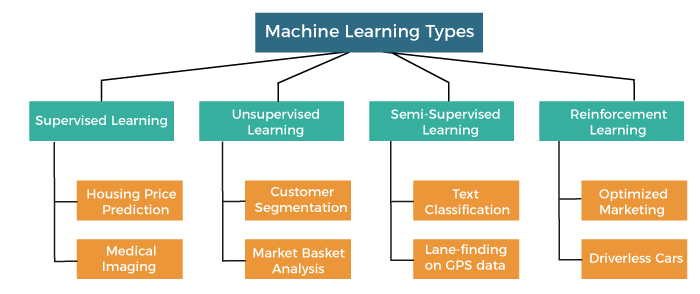
Machine learning isn’t one-size-fits-all. There are three main types, plus a hybrid fourth one emerging in 2025.
1. Supervised Learning
What it is: The model learns from labeled data (you tell it the correct answers).
Example: Email spam detection — you label emails as “spam” or “not spam.”
2. Unsupervised Learning
What it is: The model finds hidden patterns without labeled data.
Example: Customer segmentation — grouping users by purchasing behavior.
3. Reinforcement Learning
What it is: The model learns by trial and error to maximize rewards.
Example: Self-driving cars learning to navigate traffic safely.
4. Semi-Supervised Learning (Emerging Trend)
What it is: Combines both labeled and unlabeled data — efficient for large, complex datasets.
Pro Tip: For beginners, start with supervised learning — it’s easier to understand and visualize.
Real-World Examples of Machine Learning
Machine learning quietly powers much of modern life:
Industry
Application
ML Example
Healthcare
Diagnosis & drug discovery
IBM Watson analyzing cancer patterns
Finance
Fraud detection
Credit card anomaly monitoring
Retail
Recommendations
Amazon suggesting similar products
Transportation
Navigation
Google Maps optimizing routes
Marketing
Customer insights
Predictive lead scoring
Education
Personalized learning
AI-driven tutoring apps
Stat: According to McKinsey, ML adoption could boost global GDP by $13 trillion by 2030.
The Machine Learning Workflow (Step by Step)
Every ML project — from chatbots to stock predictors — follows this general process:
Define the Problem: What question do you want to answer?
Collect Data: Use APIs, sensors, or open datasets.
Preprocess Data: Handle missing values and normalize numbers.
Split Dataset: 80% for training, 20% for testing.
Train Model: Choose an algorithm (e.g., Decision Tree).
Evaluate Performance: Check accuracy, precision, recall, or F1-score.
Optimize & Deploy: Tune parameters and deploy using APIs or apps.
Example: Predicting housing prices → gather data (size, location, rooms) → train → predict price for a new home.
Top Algorithms Every Beginner Should Know
Understanding algorithms helps you choose the right tool for your problem.
ExposureNinja-style Tip: “You don’t need to know math by heart — but understanding how each algorithm behaves helps you explain results clearly to clients or employers.”
Essential Tools and Libraries (Free + Beginner-Friendly)
Start your ML journey with these free, open-source tools:
Purpose
Tool
Why It’s Great
Coding
Python
Easiest language for ML
ML Framework
Scikit-learn
Beginner-friendly for algorithms
Deep Learning
TensorFlow / PyTorch
Industry-standard frameworks
Visualization
Matplotlib / Seaborn
Make data insights visual
Data Handling
Pandas / NumPy
Clean and analyze datasets
Experimentation
Google Colab
Free GPU-powered environment
Bonus: Google Colab lets you run code in the browser — no installation needed.
Common Challenges in Learning ML — and How to Overcome Them
Challenge
Solution
Too much math jargon
Focus on concepts first; learn math as you apply.
Messy data
Use Pandas for cleaning and preprocessing.
Overfitting
Split data properly; use regularization techniques.
Hardware limits
Try cloud-based tools like Colab or Kaggle.
Staying updated
Follow blogs like TowardsDataScience, Analytics Vidhya, or Google AI.
🧩 Real Example: When I built my first ML model predicting coffee sales, I learned that data cleaning took 70% of the effort — not coding!
Machine Learning vs. Deep Learning vs. AI: What’s the Difference?
Concept
Definition
Example
Artificial Intelligence (AI)
The broad field of creating intelligent systems.
Chatbots, automation tools
Machine Learning (ML)
Subset of AI where systems learn from data.
Email spam filters
Deep Learning (DL)
Subset of ML using neural networks.
Image and speech recognition
In short: AI is the goal, ML is the method, Deep Learning is the technique.
How Machine Learning Impacts Everyday Life
Machine learning is everywhere — often unnoticed:
Your phone unlocks via face recognition.
Spotify curates your perfect playlist.
Banks flag suspicious transactions instantly.
Smart thermostats adjust to your preferences.
2025 Insight: With edge computing and 5G integration, ML models now process data directly on devices — improving speed and privacy.
Ethics, Bias, and Responsible ML
With great power comes great responsibility. ML models can unintentionally inherit biases from data.
Ethical Best Practices
Use diverse, representative datasets.
Audit models regularly for bias.
Keep models transparent and explainable.
Respect privacy and data rights (GDPR compliance).
Trust Tip (MonsterInsights-style): Transparent ML practices boost trustworthiness, an important E-E-A-T factor for Google rankings.
Free Tools to Learn and Experiment with ML
You don’t need to spend a cent to start learning ML.